Hide the Frontier
An excerpt from The Privatization of American Foreign Policy
October 2026
The following essay is taken from my longer paper, The Privatization of American Foreign Policy. I have pulled this section out separately because I think it is the best part and can stand on its own two feet. And everyone likes a shorter essay.
The United States government should have exclusive control over access to the frontier.
Today, AI labs decide who builds this technology and under what conditions. Component producers, such as Nvidia, get to decide who can purchase their goods. And—the final abdication in this chain—the labs functionally have total control over how, when, and to whom they release their newest models. This third set of decisions similarly belongs to the people and their elected representatives, not to private corporations. One solution to this is that the U.S. government will hide the frontier.
To get to that conclusion, we begin with a few premises.
First, the U.S. has a lead in AI. This is one of the more contested questions in AI today, and estimates vary on the duration and long-term sustainability of that lead. However, the consensus view is that U.S. labs enjoy a lead at the frontier of AI capabilities, and most converge around the 4-8 month range. The U.S. government’s Center for AI Standards and Innovation (CAISI) estimates that the lead is close to 8 months; Epoch AI averages the lead since 2023 at 7 months, with previous gaps as small as four months and as large as fourteen; SemiAnalysis puts its estimate of the gap between open and closed models at around 5 months, and shrinking with each major transition in AI (early scaling, reasoning, and agentic); the research center SaferAI found that Z.ai’s GLM-5.2 trailed the U.S.-led frontier by two to four months; and at a recent panel conversation at the Harvard Kennedy School, former U.S. national security advisor Jake Sullivan put the lead at around 6 months. There are some dissenters, but for the sake of this argument I will yield to conventional wisdom.
Second, the capabilities of current Chinese models are due, in part, to their ability to distill from publicly available frontier U.S. models. Like the estimates above on the extent of the U.S. lead, the degree to which Chinese capabilities are directly derivative of U.S. capabilities is debated and difficult, if not impossible, to fully quantify. We are left to infer from the reports from the labs, the U.S. government, and research institutes precisely how significant distillation is. Here is Anthropic’s report from February:
We have identified industrial-scale campaigns by three AI laboratories—DeepSeek, Moonshot, and MiniMax—to illicitly extract Claude’s capabilities to improve their own models. These labs generated over 16 million exchanges with Claude through approximately 24,000 fraudulent accounts, in violation of our terms of service and regional access restrictions. Distillation can also be used for illicit purposes: competitors can use it to acquire powerful capabilities from other labs in a fraction of the time, and at a fraction of the cost, that it would take to develop them independently.
A later Anthropic report updated that number to reflect an enormous uptick in this activity:
approximately 200 million exchanges across five campaigns, and seven China-based labs identified, with Alibaba’s Qwen team accounting for 151 million of those exchanges alone.
A U.S. government report from last month arrived at the same conclusion:
China-based artificial intelligence (AI) companies are engaging in aggressive, industrial-scale distillation activities that systematically extract restricted proprietary functionalities and capabilities of U.S. frontier AI models with the purpose of training their own.
While distillation is recognized as a legitimate and useful technique in AI research, China-based companies’ use of distillation against U.S. models enables Chinese AI models to continually close the technology gap without expending high research and development costs and resources, including for compute, electricity, and foundational research, required for producing frontier AI models. Advances of Chinese AI models, consequently, enhances its military and cyberattack capabilities that could be used against the U.S. and our Allies.
The full government report goes as far as to say that the distillation campaigns “form the core—not merely a supplement—of their AI development strategy.”
Whether adversarial distillation by AI labs in the PRC is the ‘core’ of their strategy or merely one part of it, we know that it allows them to develop in a manner asymmetric to their compute reserves and technical capabilities, because distillation requires less compute and less technical ability than building a model from scratch. The upshot is that the small lead the U.S. has over China is being shortened by the ability of Chinese labs to distill from American labs. By denying that route to model capability, the U.S. is able to better safeguard its lead at the frontier.
One piece of supporting, though orthogonal, argumentation comes from the pacing debate. A subset of the safety-minded pacers argue that we should not worry about the risk of China overtaking us if we decide to slow the pace of innovation because it is only on our coattails that the Chinese labs appear to be catching up. If we slow, the Chinese labs will necessarily slow too, because their frontier models are distilled and thus downstream of our frontier models. Matt Sheehan’s image is a speedboat pulling a wakeboarder: if the speedboat speeds up, so will the wakeboarder. It's a crude and imperfect metaphor, but it does reveal a quality to this competition: that China’s capabilities are, to a greater or lesser degree, built on American capabilities.
Put another way, one reason that Chinese labs are n months behind and not n+x months is because they enjoy the fruits of distillation. A goal of U.S. policy ought to be increasing the value of x.
Third, as these reports reveal, distillation occurs through access to frontier models via the API. Anthropic’s own report on how adversarial distillation works illustrates this:
Illicit distillation is typically enabled by fraud: sophisticated networks of fake accounts created with stolen credit cards, login credentials, and API keys.
Over the last several months, unauthorized labs have developed increasingly sophisticated methods to circumvent our defenses and harvest the capabilities of US frontier models. These labs generally access Anthropic’s models by routing requests through proxy services, also known as “transfer stations.” To circumvent our geographic restrictions and related controls, these proxy services create thousands of new accounts using false identities, fake or stolen credit cards, and stolen API keys. They will often use stolen API credentials belonging to legitimate companies or individuals to give unauthorized entities access to US frontier models.
Once access is secured, the labs generate large volumes of carefully crafted prompts designed to extract specific capabilities from the model. The goal is either to collect high-quality responses for direct model training, or to generate tens of thousands of unique tasks needed to run reinforcement learning.
What the reports reveal is that these are sophisticated attacks on the labs’ products, enabled by one key vulnerability: open, at-scale access to frontier models through their APIs.
The attempts to geographically restrict access to their models have proved insufficient, by their own admission. If blocking distillation is something we want to achieve, another route must be taken.
The conclusion that seems intuitive is that, in this narrow context, the U.S. does not need to slow its development to slow China’s development: rather it needs to completely cut off all unapproved access to the frontier. U.S. labs should produce, but not release, the most advanced AI models and only make public (and thus distillable) the sub-frontier model. Their most capable models should, by law, stay under the umbrella of the U.S. government and those private actors that it, not the labs, determines ought to have access.
As it currently stands, the government has functionally no role in the decision of when, to whom, and under what conditions a new model is released. To the extent that the government does step into this chain of events in a structured and consistent manner at all, it is loose and unserious: labs can voluntarily submit their next model to a safety review by CAISI before release and have voluntarily (and non-bindingly) committed to embedding third party evaluators inside. These are both woefully inadequate responses. Most important, these are all voluntary: the labs do not have to submit models to CAISI (in fact, Meta still has not signed the voluntary pre-release safety review agreement with CAISI) and the evaluators are in the labs only until the point the labs decide they no longer want them around.
This structure has both practical and principled flaws. First, these commitments do nothing to obviate the underlying reality that this is still an abdication of responsibility from the government to the private sector. The government does not mandate anything. It is pleased that the labs have made a decision of their own accord but they are all non-binding and the government has shown no interest in implementing actual regulations if the labs decide, tomorrow, that they no longer feel like having third party evaluators around. The same goes for the fact that the labs are not releasing unsafe models onto the internet which fail to meet their alignment standards. I suppose that’s a good thing, but perhaps just because our expectations are so low. While the decision to shelve an unsafe model is obviously preferable to the alternative, it is nevertheless lacking for the same reason: it is fundamentally a decision they are making for themselves with their own interests in mind. Hoping that our interests and theirs will forever align is not a strategy. It’s embarrassing. That a government representative of its people will so debase itself to the supposedly unyielding and unfailing wisdom of alleged visionaries.
Given the distillation threat sketched above alone, this choice of when and to whom new models are released is a core national security question and one the government gave up on trying to answer, pawning it off to the labs.
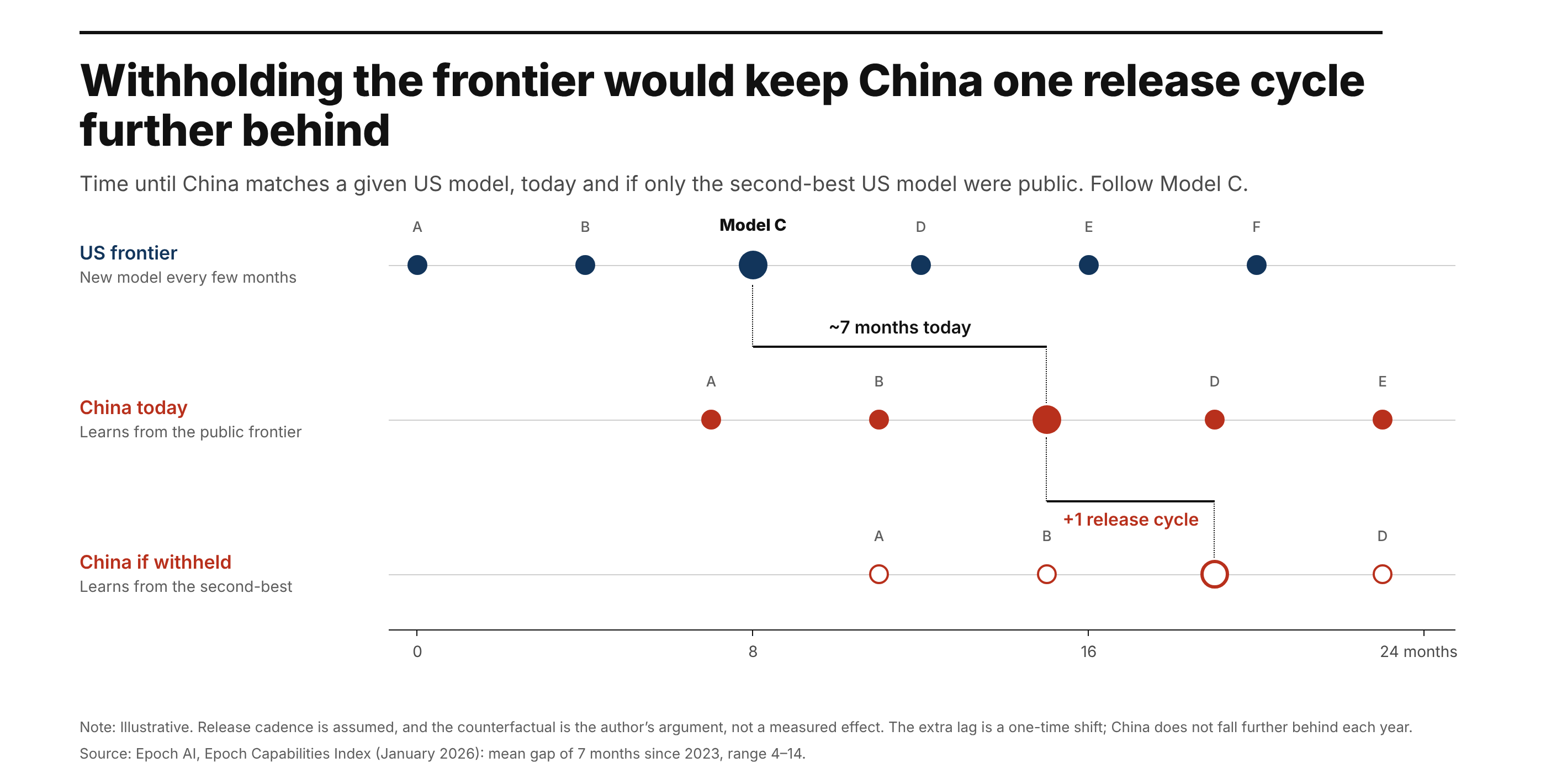
A possible solution to this problem is much closer to hand than one might think. In fact, we can thank Anthropic itself for providing the model. Currently, Mythos has been withheld by Anthropic, allowed to be used by only approved individuals and enterprises, through its Project Glasswing. That role, with that structure, should be moved under the control of the government: with the development of each new frontier model, the government would be given first and exclusive access for deployment in cybersecurity, biosecurity, infrastructure security and the like, and would determine which private sector partners exhibit similar needs. That model would not be made publicly available until it is no longer the frontier, at which point it is released and replaced by the next frontier-level model. In this way, the United States government and its chosen key partners are always one model release ahead of the public and the Chinese labs dependent on distillation for their capabilities.
The rough diagram below illustrates what one might hope to achieve by withholding the frontier from Chinese labs.
Notes
- Are Open Models Catching Up?, SemiAnalysis; CAISI Evaluation of DeepSeek V4 Pro, NIST; Chinese AI models have lagged the US frontier by 7 months on average since 2023, Epoch AI; Jake Sullivan, Ylli Bajraktari Warn of Narrowing Gap in AI Development Between U.S. and China at IOP Forum, The Harvard Crimson; GLM-5.2 Risk Evaluation Report, SaferAI.
- The Stanford HAI report makes the claim that the lead is functionally nil: Artificial Intelligence Index Report, Stanford HAI.
- Detecting and preventing distillation attacks, Anthropic.
- Anthropic’s 200M-Exchange Distillation Report Is the Evidence Behind the Joint US Intelligence Accusation, Forkast.
- NSA and Others Warn China-Based AI Companies are Distilling U.S. Frontier AI Models, NSA.
- China-Based Artificial Intelligence Companies Conducting Industrial-Scale Distillation Campaigns Against U.S. AI Companies.
- Matt Sheehan made this argument on The Ezra Klein Show: The ‘But China!’ Dilemma Driving the A.I. Race, The New York Times.
- Detecting and countering misuse of AI: September 2026, Anthropic.
- Detecting and preventing distillation attacks, Anthropic.
- You would be correct to note that the government has intervened in the past, though I think the argument remains standing. In June, the Commerce Department gave Anthropic roughly 90 minutes to suspend access to Fable 5 and Mythos 5 for all foreign nationals, and the controls were lifted within three weeks. In July, the White House asked OpenAI to limit GPT-5.6 to a small group of approved partners for its first two weeks, and OpenAI agreed. These are the exceptions that prove the rule. Neither rested on a statute or a published standard. One came from Commerce by letter, the other from the White House by request, and neither was explained to the public. Anthropic itself, in its statement on the order, said the government “should have the ability to block unsafe deployments, as part of a statutory process that is transparent, fair, clear, and grounded in technical facts,” and that “this action does not adhere to those principles.” I agree. A government that acts on frontier releases only through improvised letters and private phone calls has not reclaimed the decision; it has shown it still has the power to, and declined to build the institution that would properly deploy it.