Plunder
November 2026

There is a well-established and thoroughly researched body of work on the relationship between AI advancements and global development goals. This is not so much an attempt to contribute to that body of work as it is to engage with it and consider its geopolitical implications.
There is a three-step process—assuming a continued, if not accelerated, progression of AI capabilities—which threatens to create the largest and most acute challenge to the promise of international development in its history. First, back-office and service work will be hollowed out, rendering unemployed wide swathes of low- and middle-income populations. Second, manufacturing and agricultural labor will also be replaced by rapidly improving robotics systems, further compounding the unemployment crisis. Third, those countries will be able to reap only a fraction of the benefit of the deployment of those systems across their economies, with the vast majority of the wealth being routed to San Francisco and Shenzhen. In practice, we will see development freeze at its current position, if not regress. The geopolitical, strategic, and security implications of billions of people functionally stuck, with no hope for material improvement, while a select few nations take off, cannot possibly be overstated.
In an essay for the Financial Times, the economic historian Adam Tooze wrote that the best historical analogy to the AI industry is not the Industrial Revolution or the Manhattan Project but European imperialism. His argument is fundamentally correct, but for a reason he does not explicitly note. The age of sprawling empires, run from London or Paris or Madrid, but operating in India, Mexico, or the Caribbean, is the apt analogy because those empires, like the new empires of Anthropic and OpenAI, raped and plundered the Third World for the marginal dollar and siphoned the money back to their gilded capitals, far from the site of exploitation but swimming in its fruits.
A frighteningly similar dynamic threatens to recur.
The First To Go
The first step is not hard to imagine. Across low- and middle-income countries, millions of people are employed today as back-office employees for foreign companies. They are employed to sift through data, assist with accounting, and fill thousands of call centers. These jobs are profoundly vulnerable to automation, threatening to render chunks of the growing, and developmentally necessary, white-collar labor force entirely redundant. In India alone, that represents six million people; in the Philippines there’s another two million; across Latin America, another two million. Those jobs will be automated away, with advanced systems built by American and Chinese labs taking the jobs and taking the income. Money that would have been spent on the next employee will instead go towards an enterprise contract with Anthropic. For the labor market, that implies one obvious problem. For the national economy, it is a potentially material decline in the tax base and the country’s future growth: the marginal dollar will leave the country, rather than stay.
It would be a mistake, however, to think that the disruption will be localized to just back-office workers. Those are likely to be the first to go, but will by no means be the last. In the United States, the conversation over AI’s labor market impact is currently focused on the threat to white-collar work: legal associates, software engineers, and other assorted email jobs are first up on the chopping block. If that risk is real here, it feels strange—perhaps downright misguided—to assume that a similar dynamic will not take place around the world. Why would the managing partner of a leading Indian or Thai or Nigerian or Kenyan law firm not similarly seek to dismiss his expensive associates and paralegals in favor of a cheaper, more efficient, and better AI system? The same goes for the CEO of a software company or a consulting firm. The entire white-collar workforce is as exposed in developing countries as it is here, and only myopia would lead one to conclude that enterprising and ruthless corporate leaders would not follow the same path towards workforce consolidation. The economic upshot is, again, not just a shriveled workforce and a lower tax base, but also the flight of capital away from salaries at home and into labs abroad.
One might hope, perhaps, that open-source or domestic models may mitigate some of these risks. False hopes. First, even if that is true, it does not solve the unemployment crisis that will follow from the widespread diffusion of these systems across white-collar work: whether the model is American or Indian does nothing to change the fact that it will be replacing an Indian human. Second, it assumes that the frontier labs will not be so much better and cheaper as to make choosing a second-tier domestic system a needless self-inflicted injury. As the last few releases from OpenAI in particular have demonstrated, closed near-frontier models can be deployed at very low cost, cheaply enough to compete with human labor on many tasks. And third, supposing that one chose to run an open-source model anyway, that will do little to obviate the broader issue: the business’s spending will be rerouted away from the domestic economy and into the hands of the new imperialists. This results from the fact that running an open-source model in Lagos or Bangalore is built on two possible compute stacks. One option is for that professional services firm to build local compute capacity. In practice, this means purchasing advanced semiconductors capable of running inference from Nvidia, an American company. Or, more likely, they would rent compute from a cloud provider, such as AWS or Google. Given that there are very few local compute providers, most AI spending would then be routed to one of the dominant American hyperscalers.
The structure of the AI stack is such that there are few, if any, opportunities for low-income countries to participate in the boom: they will be users, and thus victims.
Global economic development has been premised, in part, on the upskilling and economic uplifting of low-income countries. Through carefully calibrated investment plans, international aid and loan programs, new trade agreements and more, countries across the Global South were supposed to see their people become more educated, transition away from agriculture or other manual labor, and modernize their nations. To call the shock to the services sector, and particularly white-collar services, outlined above merely a disruption does a disservice to the potential scale of this event. It represents a fundamental upset in the theory of international development.
Reading this, one might reasonably note that these kinds of service jobs do not make up a large component of these economies and so the employment disruption won’t be so severe. The trouble with that analysis is that, while it may be true, it was precisely those service and white-collar jobs that were supposed to be the future for the Global South. That was the path to prosperity. To say that they may not exist in the near future is to say that the development path is closed. On that trajectory, we risk confining hundreds of millions of people—the fastest-growing populations in the world—to a future that resembles the past, not even the present. We will have built an unbreakable silicon ceiling, above which all work is automated, with the revenue flowing to California. Below it, the developing world will be consigned to a life that looks something like 1999.
The Ceiling Lowers Again
1999 might even be a luxury. To take Anthropic’s most recent model release as an example, we seem to be at the foothills of an explosion in AI-enabled robotics capabilities. In the space of a single model jump, Anthropic doubled the robotics capabilities of its frontier model. To the extent that advanced robotics is currently being held back by software and not hardware bottlenecks, we are seemingly inching ever closer to that industry’s GPT-3 moment.
These physical systems will initially be expensive and new chokepoints will certainly crop up: we should not reasonably expect to see every factory across the developing world retooled with robots in the next two years. But given the pace of frontier development over the last five years, the spread of physical AI across the global economy looks highly likely, if not inevitable. The implication of this is that, while large language models may impose a ceiling on development in low-income countries within the next year or two, it is possible that physical systems lower that same ceiling even further. With each new capability leap celebrated in the Bay and on Wall Street, the opportunities for global development will shrink in equal measure. The ceiling will continue its jagged downward journey, building the pressure in the space below it. But at what point does the pressure get too high, causing something to break?
Of the categories of physical labor that sustain developing economies, manufacturing, broadly defined, is most vulnerable to this automation. From Pakistan to Vietnam to Bangladesh to Mexico, hundreds of millions of people in low- and middle-income countries are employed in factories making everything from vehicles to chemicals to clothes to electronics to medical devices. Manufacturing accounts for a quarter of Vietnam’s GDP and employs a quarter of its workers; in Mexico it produces about a fifth of national output and employs roughly one in six workers, some 9.5 million people; in India seventy-five million people work in manufacturing.
These people are not going to wake up one morning and find that none of them have a job. Rather, a process will begin, relatively soon, in which automated systems are deployed across factory floors in the developing world, allowing the companies making these products to juice their productivity and further scale their businesses. Once the economic incentives are aligned, they will cease hiring new workers and begin laying off the current ones and, before long, manufacturing as a share of the workforce will have shrunk dramatically, with people necessary only as supervisors of robotic systems. Foreign companies will not have the incentive to retrain or redeploy those former employees somewhere else in the business: remember, in the years prior they fired all of the back-office employees they had. Nor is it reasonable to expect these economies to construct a sustainable safety net or retraining program. The result of this is an enormous population that is now unemployed, with no income stream or hope for upward mobility. The ceiling has just dropped another level.
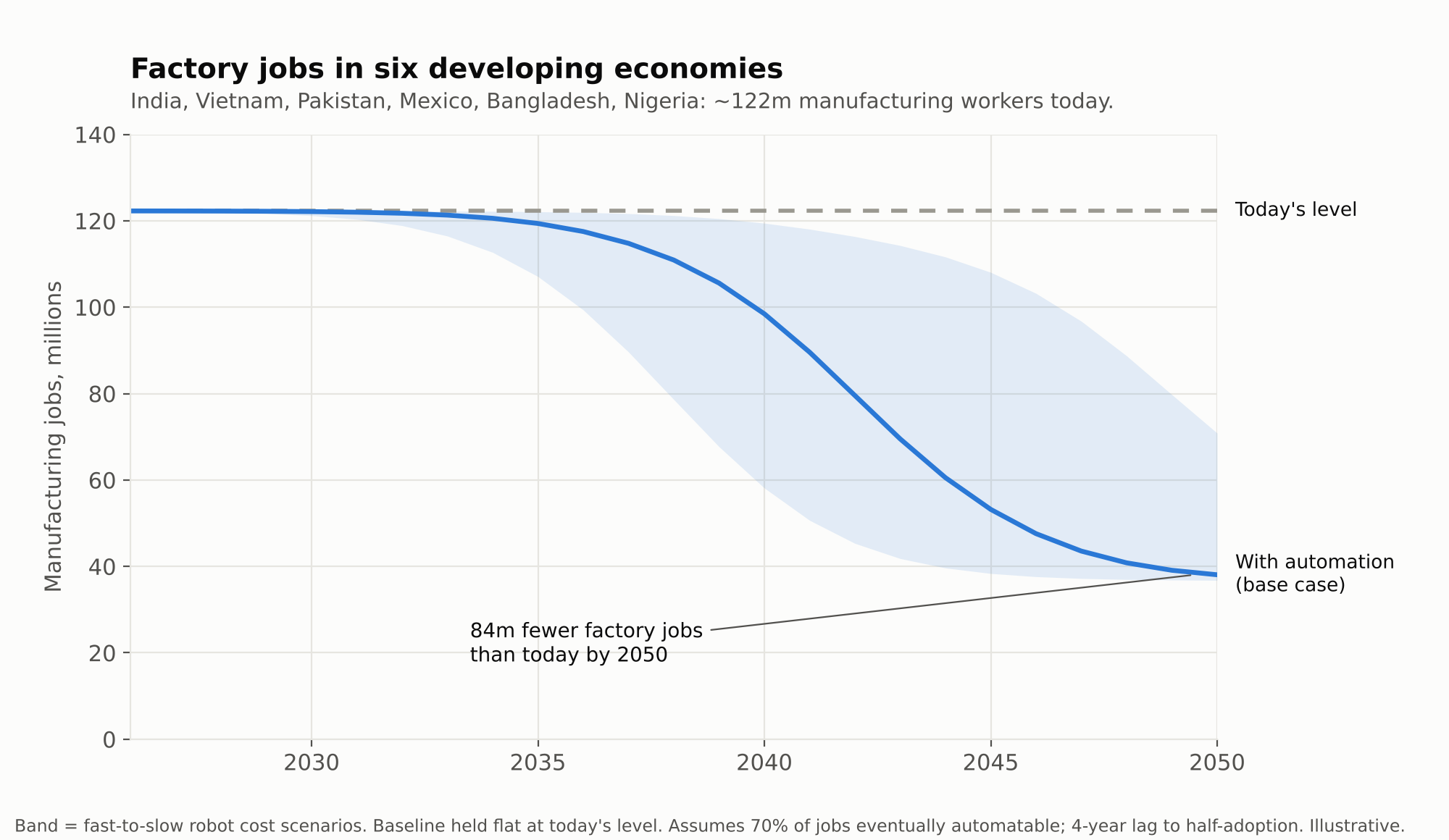
The six economies in this chart (India, Vietnam, Pakistan, Mexico, Bangladesh, and Nigeria) employ about 122 million people in manufacturing today. It illustrates that in the near future, little changes: wages in these countries are low enough that a human worker still costs less than a machine. But as robots get cheaper, factories in each country reach the point where automation is economical, and hiring stalls and then reverses. In the base case, factory employment begins to fall in the mid-2030s, drops to about 53 million by 2045, and to about 38 million by 2050, a loss of 84 million jobs, or nearly 70 percent of today’s total. The shaded band shows how much depends on the pace of progress. If robot costs keep falling as fast as they did last year, most of the decline arrives before 2040. If they fall slowly, it is postponed past mid-century, but not avoided.
The ceiling will continue dropping, eating more of these economies. With services automated away, and then manufacturing, the systems will come for commercial agriculture, gorging themselves on yet another path out of poverty. What do you do then? You start walking backwards, in time and in space.
Economic development brought millions of people off smallholder farms and into the city. Electrification, modern medicine, education, and a larger and growing income were the promise of that future. It was a better life than your parents had and provided the opportunity to give an even better life to your children. Your parents were smallholder farmers so that you could work in a factory so that your daughter might be able to go to university and get an engineering job. In the space of three generations, life had been radically transformed. But now the jobs are gone, and the money too. Doctors are still needed, but the demand-supply delta is so vast that for every open place there are hundreds of graduating medical students. The same is true for all the jobs. And so begins the retreat. Bags are packed to move home, to move to the past, not the future. The only economy that can exist for the vast majority of people across the developing world is the economy of 1899, not even 1999.
This may read like doomer dystopia slop. I wish it were. But Bangladesh today is already on this path, on the back of very limited automation. For two decades it followed the textbook path out of poverty: factories drew millions from the villages into paid work around Dhaka. The reverse is true today. To take just the garment industry as illustrative, between 2010 and 2024, Bangladesh’s garment exports rose from $12.5 billion to $40 billion, while the number of workers needed to produce $1 million of exports fell from 220 to 90. Across manufacturing as a whole, output grew by about 9 percent a year between 2016 and 2022 while employment fell by almost 10 percent. Factories shed around 1.4 million jobs in the decade to 2023. As automation led to displacement, workers did not move up into services but back down the development ladder into agriculture. Agriculture’s share of employment rose from 40.6 percent in 2017 to about 45 percent in 2024, even as farming’s share of GDP fell to 11 percent. The World Bank estimates that between 2016 and 2024 Bangladesh created about 900,000 jobs a year for 2 million new entrants to the labor market, and that seven in ten of those jobs were in agriculture. Among young workers the reversal is sharper. In 2017, 72 percent of employed young Bangladeshis worked outside agriculture; by 2024 only 48 percent did. All of this has happened while sewing, the stage of garment production that employs the most workers, remains only semi-automated.
As commercial farming disappears, all that is left is to return to the smallholder farms: it is the one form of work that remains which will never be replaced by a robot, for there is no economic incentive to do so. But even there, the long artificial arms reach out to grab them: more efficient agriculture around the world pushes global prices down, further depressing the price smallholders get for whatever surplus they sell. Subsistence farming is what becomes of a population when the modern economy has no use for its people.
What the Bangladeshi example illustrates is that only limited automation can reverse decades of progress on international development and wealth creation. Bangladesh is not and will not be alone. As the silicon ceiling descends across the Global South, people will be forced down the development ladder, their knuckles stepped on by the encroaching imperialist, gluttonous, sniffing for the marginal dollar of profit wherever he can find it.

No Money For You
The new empires are recreating the Third World. Tens of millions of people will be functionally dispossessed, outside of the supply chain of economic growth in their countries. Their service industries, land for manufacturing, and farms for agriculture will be operated by artificial systems, monitored (maybe) by a lucky few domestic workers who can get a job, while the lion’s share of the spending of the few surviving domestic businesses goes to the tokens being churned out by American data centers running American models. This is the 21st century’s rape and plunder.
The labs will extract the economic value from the developing world: in any instance in which a domestic worker would have a service job at a law firm or IT company, the salary now goes to OpenAI or Moonshot; in any instance in which a worker would be paid to build cars or mix chemicals, that salary now goes to Physical Intelligence for its model and a hardware operator for its robots.
The frontier labs will essentially run the economies of the developing world from a distance, safely secured from the fallout of rendering hundreds of millions of the world’s poorest people economically neutered.
At the same time, these countries will have fewer tools at their disposal to defend against this impending dispossession. In the United States, widespread unemployment will also be an issue, but the government has a unique capability: it can tax the labs. When AI takes the job of an accountant in Cincinnati, the U.S. loses the income from that individual’s taxes but can tax the profits of the AI company which took the job. In Lagos or Dhaka, if a law firm fires a paralegal in favor of a foreign model, the country loses the taxable income and the contribution to the local economy, and has limited ability to tax the profits of the AI giant replacing its people.
Without a tax base, the country now stripped of its productive workforce will have very limited means with which to address the social crisis. With what money will they address the widespread unemployment, the growing youth populations with no futures? This final asymmetry is what makes this an imperial project. The Third World is yet again strip-mined for its resources, while the money is drained out and deposited in the gilded capitals thousands of miles away. At least the British left behind a railway system.
The Geopolitics of Plunder
What becomes of a world in which the world’s poor are permanently so? Three possible outcomes strike me as worth attention.
First, democratic systems have no antibodies to fight a challenge of this scale. The promise of liberal democracy is that, through its systems of checks and balances, individual rights, representation, and equality before the law, it creates the conditions for economic flourishing while also safeguarding political freedoms. It is unclear if such a system can long sustain itself, though, if it fails to deliver any material prosperity. Healthy democracies in high-income economies are already facing something of a legitimacy problem. Britain has had seven prime ministers in ten years, and France has replaced its prime minister almost as often. Across the developing world, a similar dynamic has played out recently: in Sri Lanka, Nepal, and Bangladesh, protesters ousted elected prime ministers over economic mismanagement, corruption, and joblessness, all since 2022. When a government fails to meet the expectations it was elected on, it will quickly be dismissed. Now imagine what becomes of recent democracies staring down the barrel of this economic nightmare. They will buckle. They will break.
If the economy is regressing, it is not unreasonable to expect the politics to regress as well. One of the driving forces of the regression, beyond the dysfunction of the economy, will be a profound desire to reclaim control and agency. A defining feature of the lowering ceiling is that control over the economy and people’s lives will shift away from their parliaments and their capitals and their homes and to shadowy labs headquartered thousands of miles away. The backlash to this denial of agency will be an attempt to seize it back. The fear is that in the face of economic desperation and mass disempowerment, people will not turn to democratically minded technocrats but to those who promise widely, blame narrowly, and govern ruthlessly. The historical record of movements of this kind is disturbing, in both its impact and its predictability.
Power politics has a habit of spilling across borders. The second outcome one could expect from an era of artificial imperialism is a fundamentally unstable security environment around the world. Not only is it the case that authoritarian regimes under domestic pressure turn to nationalism and diversionary conflict as a means of consolidating power and justifying themselves, but this new economy will force people to turn to the least artificial of all things to sustain what is left of the national economy: natural resources. Chips will still require rare-earth minerals; diamonds will still be needed in the window of Tiffany’s on Fifth Avenue; weapons systems will still require tungsten; and the demand for food, timber, and energy will not abate. A government in that position becomes a rentier state almost by default. It lives off extraction and has little reason to educate its people or listen to them. In that economy, where the only thing that developing nations can provide is their resources, they will seek more of them. They will take more of them.
Finally, and perhaps most obviously, the defining geopolitical characteristic of this new international order will be the yawning, cavernous, and growing delta between those countries in control of the new sources of economic power—the labs—and those without. This itself has a series of cascading implications, but as a descriptive matter, we risk reverting decades, if not a century, in terms of international economic inequality. Perhaps a new multitrillion-dollar international aid effort to transfer some of this wealth back to the colonies will emerge. Perhaps. But with the unemployment, dysfunction, domestic safety-net spending, and political and economic dislocation that will follow from an explosion of machine intelligence and its diffusion at home, I would not hold my breath for a renewed spirit of international generosity.
Notes
- For the existing literature, see “Artificial Intelligence, Globalization, and Strategies for Economic Development” (NBER); “AI Could Undermine Emerging Economies” (AI Frontiers); UNCTAD, Technology and Innovation Report 2025: Inclusive Artificial Intelligence for Development; IMF, “The Global Impact of AI: Mind the Gap”, WP/25/76, April 2025; and Commanding Heights.
- Writing in November 2026, when Fable 5.2 is the newest frontier model.
- Figures are illustrative, from a simple cost-crossover model, not a forecast. Employment comes from national labor surveys (India 74.5 million, Vietnam 12 million, Pakistan 11.2 million, Mexico 9.5 million, Bangladesh 8.1 million, Nigeria 7 million). The model assumes: (1) a robot doing one factory worker’s job costs $50,000 a year in 2026, based on the reported $25 an hour BMW pays for Figure humanoid robots; (2) that cost falls 18% a year in the base case (8% to 40% in the shaded band), following Goldman Sachs, which had modeled declines of 15–20% a year and observed 40%; (3) a robot’s cost cannot fall below about $1,500 a year per job, derived from Bank of America’s projection that a humanoid robot’s parts will cost $13,000–17,000 by 2030–35, spread over a five-year life and two shifts; (4) annual wages, excluding employer benefits, start at about $11,000 in Mexico, $4,200 in Vietnam, $2,600 in India, $1,700 in Pakistan, $1,400 in Bangladesh, and $900 in Nigeria, drawn from national surveys and statutory minimums, and rise 3% a year in real terms; (5) 70% of factory jobs are eventually automatable; (6) half of those jobs are automated four years after robots become cheaper than workers; and (7) without automation, factory employment would stay at today’s level.
- Not the slop part.
- Bangladesh data from the World Bank; “Garment exports triple in 15 years, but jobs remain stagnant: RAPID”, The Daily Star; the World Bank Open Knowledge Repository; and Bonik Barta.
- An important issue I have not dwelt on here is migration, as it has been analyzed in depth by others quite recently. But it is worth noting that the mass movement of millions of people in search of a better life in the developed world is going to cause a humanitarian catastrophe that nobody is prepared for.